
Prioritising Conflict Prevention in Syria’s Recovery: Integrating Climate and Environment for Peace

Download the publication
Method
This assessment connects climate risk analysis with a conflict prevention angle, translating both into actionable entry points for investment and policymaking. The assessment draws on adelphi's Weathering Risk methodology, adapted to the Syrian context, which integrates climate and conflict lenses to identify where environmental pressures intersect with fragility and where opportunities for peace exist. The analysis combines technical and policy expertise with the lived realities of communities and input from experts across 10 governorates, drawing on more than 230 household and community-level interviews, 24 expert consultations, as well as stakeholder consultations in Amman and Damascus.
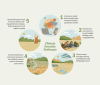
This assessment presents five climate security pathways and six targeted recommendations for those positioned to act.
Key insights include:
In Syria's fragmented media environment – characterised by the dominance of informal digital channels and widespread disinformation – grievances are systematically reframed through sectarian narratives. This dynamic marginalises minority voices, particularly those already reluctant to engage online for fear of being targeted. Moreover, as sectarian identity becomes a dominant interpretive framework, disinformation not only reflects existing divisions but actively deepens them. The consequences extend to government legitimacy. Even evidence-based policies, such as those governing natural resource, risk being reframed on social media as deliberate attempts by the government to prevent communities from rebuilding – often before any official communication has reached the public.
Young people in Syria – who constitute a third of the population – are disproportionately affected by economic fragility, repeated climate shocks, and a labour market hollowed out by conflict and agricultural collapse. This is not merely an economic crisis. Limited access to stable livelihoods can undermine young people’s social standing, sense of belonging and agency. This precarity pushes many towards informal work, migration and, in some areas, armed groups. This dynamic of exclusion deepens their disengagement from civic and community life.
In Syria, climate change is primarily experienced through its immediate manifestations – such as a failed harvest, a dry well or an unpredictable season – rather than as a longer-term structural trend. In a context of acute and compounding crises, this gap in awareness and prioritisation is human. Yet its consequences are significant. Decisions being made now about where people return, how water is extracted and how regional trade is structured will lock in trajectories that are difficult and costly to reverse. Where climate considerations are not integrated, maladaptive practices can become structural. Meanwhile, where climate considerations are integrated but disconnected from lived realities, even sound policies risk being perceived as abandonment.
Climate pressures are landing in an environment where natural resources and services are severely strained and access is deeply unequal – both in practice and perception. With ministerial mandates and cross-sectoral coordination still being established, the institutional choices being made now are not simply technical, they will determine whether access becomes more equitable or whether existing patterns of exclusion are carried forward.
Syria's agricultural sector is facing pressures from multiple directions. The legacy of conflict, climate stress and exposure to international markets are interacting in ways that risk tipping farming communities beyond what they can absorb alone. Until now, farmers have been navigating these pressures alone, adopting coping strategies that are rational at the household level but accelerate environmental and economic deterioration at scale. Female-headed households, herders and rainfed farming communities in the north of the country face the steepest barriers. In contexts where vulnerability is most acute, the risk of grievance, social fragmentation and instability runs deepest.
Strategic recommendations for conflict prevention:
The agricultural stability zones, introduced in 1975, are now widely seen as inequitable and a significant source of public grievance. A transparent and participatory review could contribute to evidence-based water management, while also offering the new administration an early opportunity to rebuild public trust and demonstrate its commitment to fair governance. The review should incorporate up-to-date climate projections and hydrological data, and be grounded in the contextual realities into which it will feed. In settings where information spreads through informal digital channels and communities are preoccupied with immediate needs, the legitimacy of the reform process – and how it is communicated – matters as much as its technical substance.
Job creation and SME development should be designed to be both equitable and climate resilient, avoiding investment in livelihoods and value chains that are likely to be undermined by climate change. Employment programmes that bring divided communities together around shared economic interests through, for example, cross-community cooperatives in climate-adapted agriculture, renewable energy installation and maintenance, and water-efficient technologies should be prioritised.
Support should be given to restoring agricultural extension and veterinary services, while ensuring they are equitable in reach and informed by current climate risk data. The rehabilitation of these services is not only a technical necessity, but also a signal of the state's renewed commitment to rural communities – many of which felt systematically neglected or punished under the previous regime.
Infrastructure rehabilitation should be designed to deliver social cohesion alongside service restoration, ensuring equitable access across formerly divided communities, inclusive community-level governance and the recruitment of local workers from diverse backgrounds. When delivered fairly and transparently, these projects provide some of the most visible peace dividends available to the new administration and are critical to building trust in communities where access to infrastructure was previously weaponised as a tool of control or punishment.
Use common environmental and service provision challenges – such as water scarcity, access to electricity, waste management and land degradation – as non-politicised entry points for local dialogue and reconciliation, including via social media, between communities that may otherwise have little basis for constructive engagement. Ensure that these dialogue and reconciliation processes are genuinely inclusive of marginalised groups, including women, young people, displaced communities and vulnerable returnees.
Download the publication
The description was excerpted from weatheringrisk.org.


